
The Curious Cases of Robin & Nero
What Portion Was History? What Portion Was Myth?
Joshua Newton
2 min read
By Joshua Newton
The Curious Cases of Robin & Nero
History is not cruel all the time. Sometimes it is playful. Sometimes it toys with us. It keeps its secrets in margins. In footnotes. In the half-asleep handwriting of monks who never imagined an audience. Centuries later, we read them as if they were messages in bottles. Not warnings. Corrections.
“As flies to wanton boys are we to History. It kills you for sport.” Or, as in the case of Robin Hood, it also waxes lyrical about you.
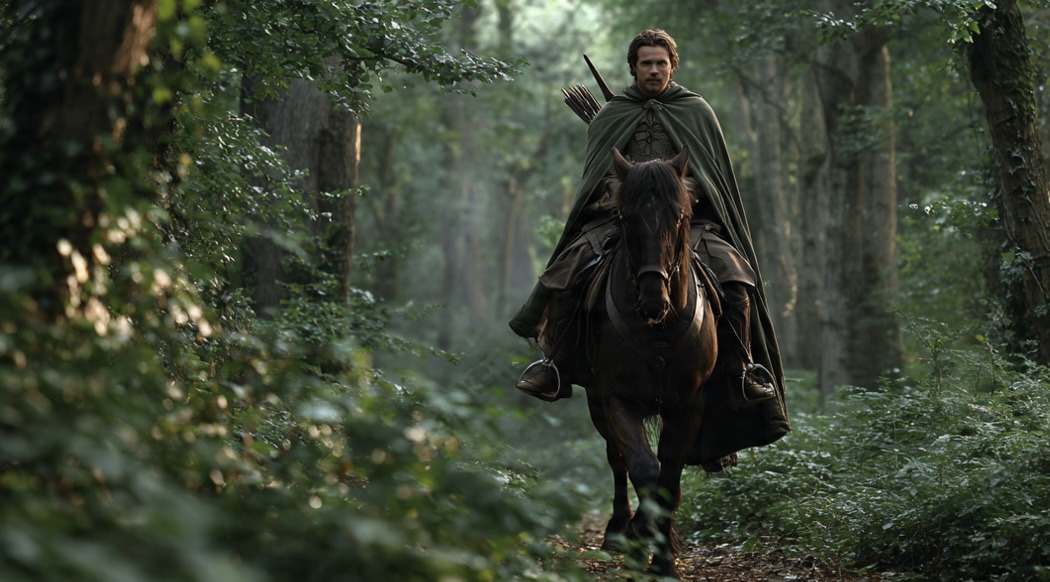
I had begun to love the brat all the more after he acquired the face of Kevin Costner. The grin. The accent that wandered. The certainty that virtue, once loosed into the forest, could never be fully hunted down.
But myths age. And sometimes they rot.
A 550-year-old Latin note, hidden quietly in the library at Eton, has begun to undo the green-clad legend. Scribbled into the margins of a medieval history book, it speaks in a voice that does not admire. It does not sing. It accuses.
“Around this time,” writes an unknown monk, circa 1460, “according to popular opinion, a certain outlaw named Robin Hood, with his accomplices, infested Sherwood and other law-abiding areas of England with continuous robberies.”
The word infested matters. So does law-abiding.
These comments are unusual in their hostility. Dr Julian Luxford of the University of St Andrews, who uncovered the note, points out that Robin Hood may have benefited from later rewriting. From revision softened by song. “Rather than depicting the traditionally well-liked hero,” Luxford observes, “the article suggests that Robin Hood and his merry men may not have been ‘loved by the good’.”
The note makes no mention of charity.No gold tossed back into the villages. No moral bookkeeping.
History and urban myths are often woven into immortal facts. Because we gulp them down. Because our universities want us to gulp them down just like that. Whole. Unchewed. Legends are easier to examine than people.
Consider poor Nero. He is forever tied to the line that he fiddled while Rome burned. A neat sentence. Memorable. Fatal.
Yet some accounts say that when news of the fire reached him, the extravagant emperor rushed back to Rome. That he organised relief efforts. That he paid for them from his own funds. Besides, there were no fiddles in first-century Rome. The instrument had not yet been born.
But facts rarely survive a good metaphor.
History now looks like the curious case of somebody’s body, swelling and shrinking without reason. A rumour inflates. A footnote deflates. Heroes are built. Then dismantled. Sometimes with kindness. Sometimes with a monk’s irritation, preserved in ink.
Robin Hood may yet survive this. Myths are resilient creatures. They retreat into films. Into childhood. Into the greenwood of nostalgia.
But somewhere, in a quiet library, a monk has cleared his throat. And history, briefly, listens.
A history of revision / Life Writing
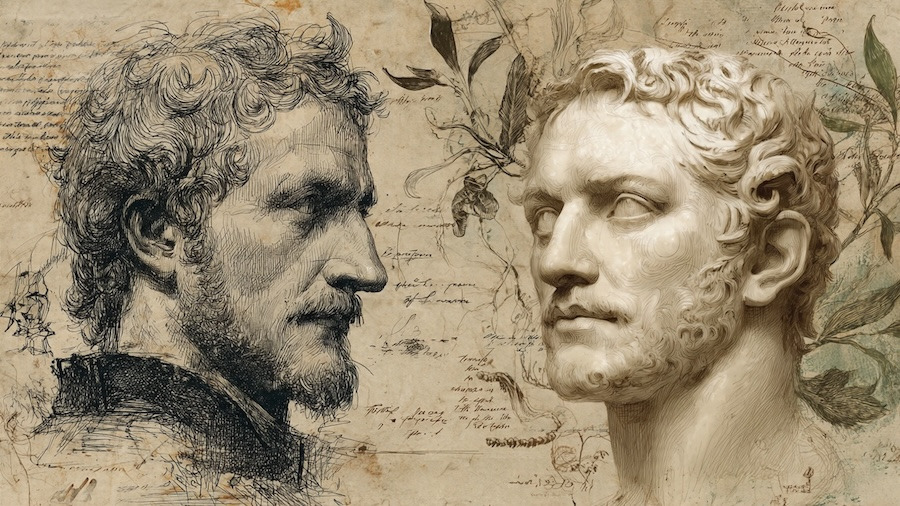
History is selective with its mercy. One face is hardened by a sentence he never lived. The other is softened by a story he may never have earned. Between them, myth does the editing.

Earthopia® is the trademark property of Bodhy Studios, founded by Joshua Newton.
All rights reserved. All content, methods, and materials on this website are protected by copyright law. Reproduction or distribution without authorisation is prohibited.
©2026 Bodhy Studios